If you walked into a financial advisor’s office and said, “I want to invest in stocks,” they would ask you, “What kind of stocks? Blue chip? Growth? Dividends? Options?”
The same logic applies to Amazon E-commerce. Saying “I want to invest in Amazon” is meaningless. There are three completely different business models operating on the platform, each with its own risk profile, capital requirement, and cash flow cycle.
Most investors make the mistake of choosing the model based on what sounds “cool” or “passive,” rather than analyzing the financial mechanics. In this deep dive, we will strip away the marketing fluff and look at the raw data: Capital, Risk, and Return.
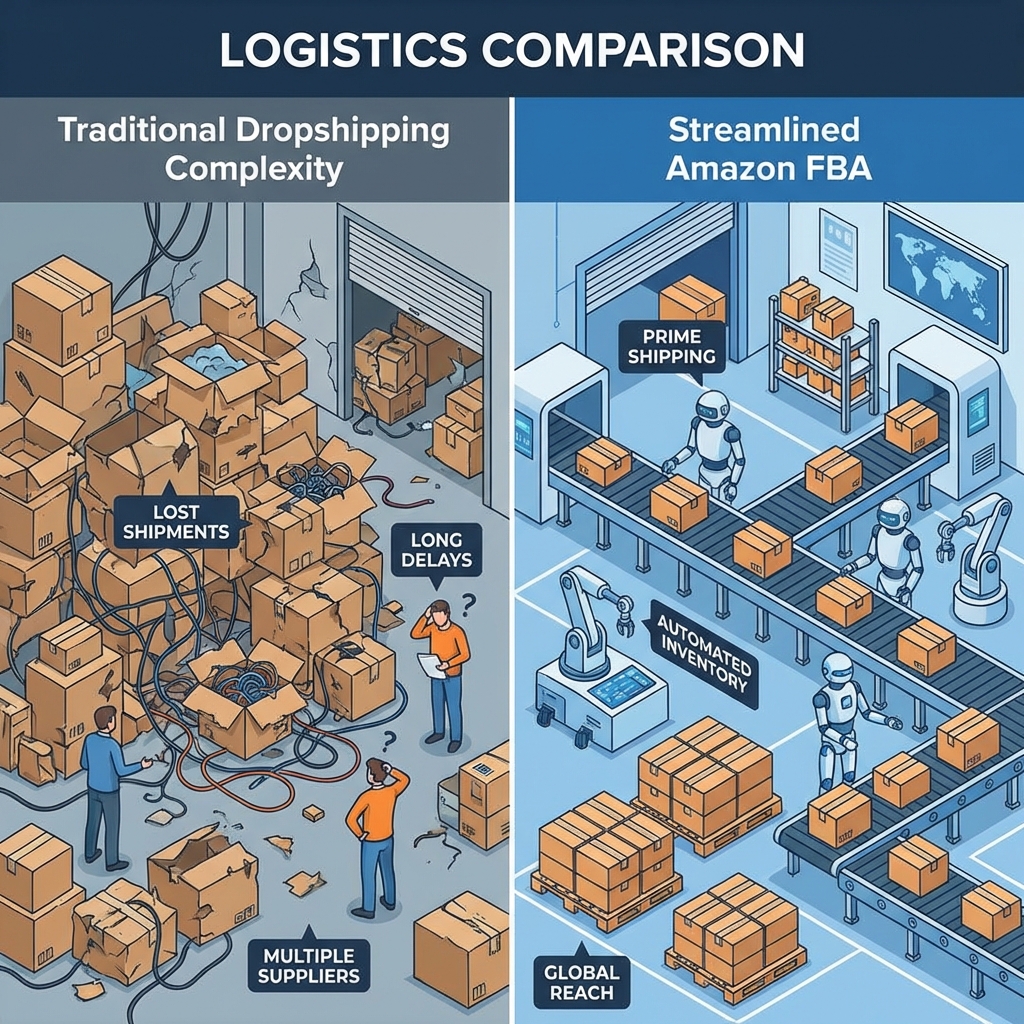
Model #1: Amazon FBA (Private Label)
The Concept: You invent a product (e.g., a garlic press), pay a factory in China to manufacture 5,000 units with your logo, ship it to Amazon’s warehouse, and spend money on ads to launch it.
The Financials
- Entry Capital: High ($30k – $50k+). You must buy bulk inventory upfront before you make a single sale.
- Cash Flow Cycle: Slow. Your money is tied up in manufacturing and shipping for 3-4 months before it hits Amazon’s shelves.
- Risk: High. If your garlic press doesn’t sell, you are stuck with 5,000 units of worthless inventory.
Passivity Score: 2/10. This is not passive. It is a full-time brand-building job. You need to handle product design, patent research, complex PPC campaigns, and social media marketing.
Model #2: Traditional Dropshipping
The Concept: You list a spatula from Walmart.com on your Amazon store at a markup. When a customer buys it, you go to Walmart, buy it, and enter the customer’s address.
The Financials
Entry Capital: Low ($1k). You only buy the item after you get paid.
Cash Flow Cycle: Fast. You get paid every 14 days, and you never hold inventory.
Risk: Extreme (Account Suspension).
Why is it risky? Because Amazon’s “Section 3” policy strictly forbids acting as a dropshipper if you are not the Seller of Record. When the customer receives a box that says “WALMART” on it, they get confused. Amazon views this as a poor customer experience and will ban your account quickly.
Model #3: The Rubel Hybrid (2-Step Dropshipping)
The Concept: This is the model preferred by institutional investors. It combines the low inventory risk of dropshipping with the high compliance safety of FBA.
We source products from retailers/wholesalers, but instead of shipping them to the customer, we ship them to our Rubel Prep Hub. We remove the retailer’s box, inspect the item, repack it in plain packaging, and ship it to the customer with your store’s name on the label.
The Financials
Entry Capital: Medium ($15k – $25k). You need working capital to float the inventory purchases while waiting for Amazon’s payout.
Cash Flow Cycle: Fast to Medium. We can list thousands of items, see what sells, and fulfill orders all within 5-7 days.
Risk: Low. Because we physically touch the product, we satisfy Amazon’s Chain of Custody requirements.
Investor Takeaway: 2-Step Dropshipping is the “Goldilocks” model. It allows for the massive diversification of dropshipping (listing 10,000 items) without the risk of an instant ban.
Head-to-Head Comparison
| Metric | Private Label (FBA) | Rubel 2-Step | Traditional Dropshipping |
|---|---|---|---|
| Startup Cost | $40,000+ | $15,000+ | $500 |
| Time to First Sale | 3-6 Months | 2-4 Weeks | 1 Week |
| Inventory Risk | High (Unsold Stock) | Zero (Buy on Demand) | Zero |
| Suspension Risk | Low | Low (Managed) | Extreme |
| Scaling Speed | Slow | Fast | Fast (Until Banned) |
Why We Bet Everything on 2-Step
At Rubel Ventures, we manage millions of dollars in client capital. We cannot gamble with “Traditional Dropshipping,” and we cannot tie up client funds for 6 months in “Private Label” product development.
The 2-Step model is the only one that offers:
- Velocity: We can test 500 new products a week without buying bulk inventory.
- Safety: We control the packaging, ensuring a perfect “Unboxing Experience.”
- Liquidity: If you want to stop investing, you stop buying. You aren’t stuck with a warehouse full of garlic presses.
The “Asset” Perspective
When you are building a portfolio, you need assets that are liquid and scalable. A Private Label brand is hard to sell unless it is huge. A 2-Step store with consistent cash flow is highly attractive to buyers because the revenue is diversified across hundreds of brands (Nike, Samsung, Lego, etc.), rather than reliant on one product.
Conclusion
If you want to build a “passion brand” and see your logo on a product, do Private Label FBA. Go on Shark Tank. Have fun.
But if you want to invest for yield—if you want cash flow that hits your bank account every two weeks without the headache of product development—the 2-Step model is the superior vehicle.
Start Your 2-Step Journey
Rubel Ventures is accepting a limited number of new partners for our Q1 2026 cohort. Secure your spot before capacity fills.